Thursday, May 14, 2026
Home Blog

Foreign Labour Migrants of Nepal – I

0

Nepalese undertaking foreign employment has increased many folds since past couple of decades. It is estimated that half of Nepali households have at least one family member working abroad or returnee of foreign employment. Remittance, mostly by the Nepali foreign labor migrants, is the backbone to Nepal’s economy, contributing approximately 25 percent to its GDP. As per the data from World Bank, remittance inflow to Nepal touched 28% of its GDP in 2018, highest in South Asian countries, with next closest country being Sri Lanka at 8.10% in the region.

Between 2008 and 2019, the Nepal’s Department of Foreign Employment (DOFE) issued around 4 million labour approvals to the Nepali citizens for work in Gulf Cooperation Council (GCC) and Malaysia, bringing up to USD 8.79 Billion per year into the country through remittance. Most of the approvals, 499102, came in the year 2014-15, which dipped to 236208 in 2018-19. During the year 2020-21, only 72,081 work permits were issued by DOFE. Between 2019-20 the government suspended issuance of labour permits (till July 2020).

As per DOFE, in 2017-2018 the major destination countries for Nepali migrant labors, for all genders, were Malaysia (29.4%), Qatar (29.1%), UAE (17.0%), Saudi Arabia (16.6%), Kuwait (5.0%) Bahrain (1.4%), Poland 1.0%), Oman (0.9%), Turkey (0.5%), Jorden (0.5%) and others (3.6%). 

In the year 2018-2019 their destination countries include, Qatar (31.8%), UAE (26.5%0, Saudi Arabia (19.5%), Kuwait (6.8%), Malaysia (4.2%), Bahrain (2.0%), Oman (1.2%), Maldives (0.8%), Afghanistan (0.8%), Cyprus (0.7%) and others (5.7%).

As for as female labor migrants are concerned, during the year 2018-19, their major destinations have been UAE (35.6%), Qatar (18.0%), Saudi Arabia (7.7%), Kuwait (7.7%), Cyprus (7.5%), Jorden (6.7%), Malta (3.2%), Maldives (2.4%), Turkey (2.1%), Bahrain (2.1%) and others (7.0%).

The Government of Nepal has set up guidelines, a nine-step process, for employment related recruitment process of the Nepali workers to other countries, which involve following steps;

  1. The employer in the destination country applies for and receives the required approval from the government of that particular country to hire foreign workers.
  2. The employer or its authorized representative submits the labor demand letter and related documents to the diplomatic mission of Nepal for verification. 

The documents to be deposited by the employer to the Embassy of Nepal include an application form, Standard Demand letter clearly indicating number and gender of workers; their basic salary; working hours; provisions of food, accommodation and transportation; medical insurance; compensation for injuries and death; in and outbound air travel and other service benefits and costs.

The employers are also bound to submit Service Agreements between Nepali manpower agencies and recruiting companies in destination countries; besides Power of Attorney issued by the company on recruiting company to Nepali Manpower Company, with their license number.

The recruiting companies have to submit two copies of the Standard Employment Contract based on job position and basic salary, to ensure that the intended workers can get equal salaries and benefits. The companies are also required to submit a Guarantee Letter to make sure that the intending workers are assigned specified work as in the contract and to ensure their safety and security. 

Other documents the recruiting companies need to submit with the Embassy of Nepal include Copy of EID of the Sponsor/Owner, Copy of Valid Trade/Commercial License of the Company and the Nepali Manpower Agency, Authentic Quota Paper from the concerned authority (if the company is private), Copy of ID of the Authorized Person (Owner/HR Manager/PRO) of the company or Authorization letter to submit and collect the documents, and ID no. and contact no. of Nepali workers working in the company, if any and their Salary Sheet of the last month.

  1. The Nepali Mission examines the employers legal and financial status, their employment records to verify the demand letter to hire Nepali workers and the terms and conditions of the demand offer. The officials of the Embassy of Nepal have the madidate, and responsibility, to check and visit and recruiting company and the accommodation of the employees before wetting the demand. 
  2. The DOFE provides pre-approval for the recruitment of workers from Nepal after receiving validated documents.
  3. The recruitment agency publishes the vacancy announcement in the National Dailies. As per Article 14 of the Foreign Employment Rules (FER), 2064 of Nepal any advertisement in this regard need to have date of prior approval from DOEF, name and address of licensee and licensee number, post of worker and number of workers demanded, description of work, minimum qualification of the worker, provisions related to housing and food, monthly remuneration, daily and weekly work periods, place and deadline of application, insurance and medical facilities, provisions related to air travel, expenses to be paid, date and place for selection of the worker. 
  4. The required process including interview, health examination, payment of insurance and welfare fund dues are completed. The process has to be on the basis of qualification, training and experience, age and physical fitness, as put in Article 16 of the FER. Besides reservations need for women, Dalit, indigenous nationalities, oppressedclass, backward areas and others, as per Article 16 (d) of FER.
  5. The Visa of the worker for the concerned destination country is received.
  6. The final labor approval is issued by DOFE.
  7. Departure of the destination country.

Given the number of reports of the rights violations of Nepali workers in different countries, which amounts to physical and mental torture and even deaths, the Government of Nepali has failed to stand and protect them. With the faulty system in place in the country, the government is adding and contributing to their miseries. Because these workers are suffering outside their homeland, the Government of Nepal cannot wash off its hands by ignoring its obligations under different domestic and international laws and protocols. 

While Article 8 of the Universal Declaration on Human Rights (UDHR) provides for an effective remedy with determination by a competent tribunal for all violations of national laws. Art. 2(3)(a) contains the same provision but for violations of the rights contained in the ICCPR. Article 8 of UDHR says, “Everyone has the right to an effective remedy by the competent national tribunals for acts violating the fundamental rights granted him by the constitution or by law”.

The government of Nepal is in violation of Article 8 of UDHR as it is allowing unregistered brokers, deceit over actual contractual terms of employment; contract substitution at the airport prior to departure; delay in investigating complaints, etc. There are also allegations of corruption. Though there is a Foreign Employment Tribunal in place, butthe process for a complaint is lengthy and bureaucratic.

As pre-medical examinations of the person undertaking foreign employment is a must but fake/distorted/ fraudulent medical certificates are provided to them. After subsequent medical examinations in their country of employment, these workers are returned back to Nepal. Under Section 72 (2) OF FEA the medical centers that provide medical certificates to such person are supposed to pay the costs incurred by the person for undertaking foreign employment, which usually never happens.

The Government of Nepal has failed to provide remedy to the violations of the rights of such workers. It has also failed to check, investigate, and punish the perpetrators in such cases. The government has also, thus, failed to protect the ‘right to move’ of its workers as obligatory under Article 12 of ICCPR and Article 13 of ADHR.

While the rights of the Nepali’s workers are being violated by their foreign employers, having knowledge of it and allowing it, puts onus on the Government of Nepal too – violation of Article 12 of the ICCPR – as the state has a positive obligation to protect liberty of movement and protect the right for an individual to leave any country while that individual is subject to its jurisdiction, under Article 2 (1) of ICCPR.

The embassies of Nepal and its Labour Attachés lack a monitoring system to check on the worker’s rights violations in different countries, which again is a violation of obligations under ICCPR.

The Government of Nepal, as its policy, has banned women below 30 years from taking employment in GCC countries on the pretext of complains received regarding physical and sexual abuse, poor working conditions and their vulnerable to exploitations of different kinds. However, evidence shows that there are a number of young Nepali women working in different countries who took their employment through illegal channels, which makes them more vulnerable and keep them at higher risk of being exploited. The Government instead need to regulate, monitor and support employment of women in these countries. The ban imposed is against Article 2(e) CEDAW, Nepal is also party to.

‘Right to Work and to Just and Favorable Conditions of Work’ is guaranteed under Article 6 & 7 of the International Convention on Economic, Social and Cultural Rights (ICESCR); besides Articles 23 and 24 of the UDHR. Recent researches and studies on the death of migrant workers in GCC and other countries have highlighted dangerous work conditions and appalling living conditions these workers are exposed to. The workers are underpaid and made to work extra without compensation. Besides, exploitative and coercive work practices, abusive workplaces and preventing them leaving them, withholding passports, identity and travel documents; and framing them in legal cases is a clear violation of Article 6 (ICESCR). Though the Nepali migrant workers do face all these violations at their working places away from the country, the Government of Nepal is in violation of Article 6 & 7 of ICESCR if it does not intervene and make efforts to safeguard their citizens working abroad.

In Nepal, while there are official guidelines in place for other foreign state and private sector employers, with the responsibilities fixed for Nepal’s missions abroad and its government in the country, exploitation of its working away citizens is going on unabated. Domestic environment for exploitation of foreign labour migrants – in the form of forced labour, slavery and human trafficking – have been itself made conducive by the government of Nepal by giving impunity to the private sector in recruitment processes, which is in violation with Nepal’s Foreign Employment Act and Rules itself. Besides, the labour laws and record of the destination countries are not looked at or examined by the Government of Nepal before entering bilateral labour agreements with these particular countries.

There is no clarification on the mandates of Embassies of Nepal and its Labour Attachés, which adds to the woes of the Nepali migrant workers abroad; besides providing impunity to the employers involved in violating rights of Nepalese citizens employed by them. As per ILO, quoting media reports, Nepal witnesses over 900 deaths of its foreign labour workers every year. These deaths are usually passed as natural deaths. The families of the deceased have been questioning these deaths. Inaction on part of the Government of Nepal and its missions encourages exploitation of its citizens working in other countries.

Nepal has its own laws on foreign employment. The Foreign Employment Act, 2064 (2008) and rules clearly fixes responsibilities on the Government of Nepal. The law has clearly laid down the provisions related to selection of institutions and works, having treaty or agreement to the worker’s destination countries (including having and disseminating information on the relevant laws in those countries), license and its renewal of institutions providing foreign employment to Nepalese citizens, refund to the foreign employment seekers, prior approval and selection process of workers, guidelines for advertisement for the foreign jobs, grounds for selections of job seekers, registration points at immigration offices at time of departure and submission of relevant documents, orientation trainings for outgoing workers, fund deposition and its use, financial assistance to the families of outgoing workers in case of his/her death during foreign employment, etc. Unfortunately, as visible from the reports and researches, these laws and regulations are violated and disrespected. 

Despite having a law in place, a number of cases have been reported where the government authorities are allegedly violating its own laws and responsibilities – for example, lack of clarity on responsibilities of Nepali missions abroad, visa facilitation centers charging multi folds more than then government fixed fees, lack of transparency of labor agreements between Nepal and other states, silence of the government – and lack of action on its part – on the reports of deaths and other rights violation of Nepalese workers in other countries, etc.

The Government of Nepal in 2015 had announced a scheme “Free Visa Free Ticket” for the outgoing Nepali migrant workers. However, the scheme turned out to be a big failure. Its failure was also acknowledged by the government in its house panel report. A sub-committee of the Parliamentary International Relations and Labour Committee also acknowledged that no migrant worker got benefited from this scheme. The report said that malpractices and cheating is dominating the sector and that the workers, going for employment in other countries, pay an amount between NPR 50,000 to NPR 9,00,000 to the recruitment agencies.

Despite the clear guidelines set up for the fee, the recruiting agencies are flaunting the regulations and there is no action from the government authorities. While the recruitment agencies are charging multi folds than the government capped fee, receipt of the actual amount charged are not provided to the job seekers. These recruitment agencies also accept the amount in cash only, which makes the process more suspicious.

As per the details available there are 1492 DOEF approved recruitment agencies in Nepal; 872 are active, 40 Inactive, 579 Blocked, and one has been suspended.

Nepal also has 143 orientation centers for its foreign labour workers; 128 active and 15 inactive. It also has MOFE approved 15 insurance companies, 18 banks, 222 Medical Centres and 14 registered RA branch offices.

The Government of Nepal has approved foreign employment of Nepalese for 110 countries through recruiting agencies. The government has temporarily blocked recruitment to two of these countries – Iraq and Libya. The DOEF has also blocked 63 foreign employers for conducting foreign employment in Nepal – 52 from Malaysia, 5 from Saudi Arabia, 3 from UAE and 3 from Qatar.

While rights of Nepali workers are being violated in other countries by their employers, there is a need to call on these countries to respect their rights and oblige with international obligations and protocols. However, it becomes more important to call on the Government of Nepal and its relevant authorities, besides Nepali missions abroad, to protect the rights of its own citizens. 

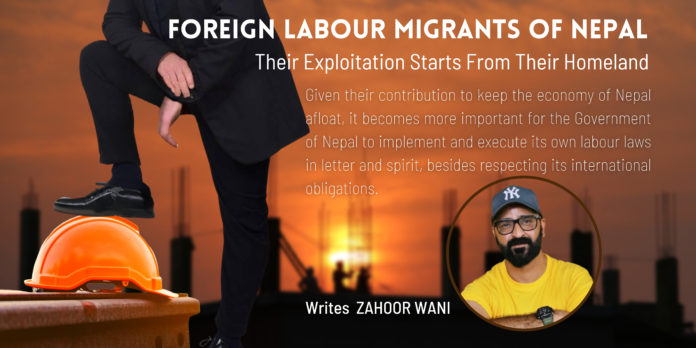
The human rights violations and abuses, and exploitation, of Nepali workers abroad need to stop, but it has to begin from home. Given their contribution to keep the economy of Nepal afloat, it becomes more important for the Government of Nepal to implement and execute its own labour laws in letter and spirit, and respect its international obligation. 

“The opposite of poverty is not wealth; the opposite of poverty is justice” – Bryan Stevenson

…… To Be Concluded.

मेयर बालेनलाई खुला सल्लाह

२०७९ जेठ १२ गते तपाईँ काठमाडौं महानगरपालिकाको नगर प्रमुखमा विजयी हुँदा सबै तहका जनताले कति हार्दिकताका साथ खुसियाली मनाएका थिए भन्ने हामी यतिखेर स्मरण गरिरहेका छौँ। त्यतिबेला काठमाडौंबासी मात्र होइन, तपाईँको मतदाता नभएका हामी जस्ता देश तथा विदेशमा बस्ने नेपालीले तपाईँप्रति धेरै ठूलो आशा राखेका थिए।

पदभार ग्रहण गरेपछिको कार्यपालिका बैठकमा मिडियालाई पहुँच प्रदान गरेर राम्रो सुरुवात गर्नुभएको थियो। काठमाडौंँको लामो समयदेखिको फोहोरमैला व्यवस्थापनको समस्या समाधान गर्ने प्रयासमा तदारुकतासाथ लाग्नुभयो। तपाईंले निजी क्षेत्रलाई विश्वासमा लिएर उनीहरूको शौचालय लगायतका सरसफाइ सुविधाको सार्वजनिक प्रयोग गर्न दिनका लागि मनाउने काम गर्नुभयो। व्यापक बन्दै गएको भौतिक पूर्वाधारको मर्मतसंभारसम्बन्धी समस्यालाई उचित संबोधन गर्ने सोचका साथ ‘पूर्वाधार एम्बुलेन्स’ को रचनात्मक अवधारणा पनि अघि सार्नुभयो। जसको हामी प्रशंसा गर्छौं।

तर तपाईं नेतृत्वको महानगर सरकारका पछिल्ला निर्णय र कार्यहरू एकपछि अर्को सार्वजनिक विवादमा तानिएका छन्। टुकुचा खोलालाई प्राकृतिकरूपमा पुनर्जीवित गर्ने तपाईँको मनसाय आफैँमा गलत थिएन। तर जय नेपाल सिनेमा हलको प्राङ्गणको जग्गा खन्नुपूर्व टुकुचा खोलालाई पुनर्जीवित गर्न मिल्ने/नमिल्ने कुराको निक्र्योल गर्न पुरातत्त्व विभाग लगायत सरोकारवालासँग परामर्श गरी यस खोलाको धरातलीय यथार्थको गहिरो अध्ययन गरिनु पर्थ्यो। काठमाडौँका भूमिहीन सुकुमबासी र अव्यवस्थित बासिन्दाको संयुक्त रूपमा प्रमाणीकरण गर्ने कुरालाई प्राथमिकतामा राख्दै तपाईँले काठमाडौँं महानगरपालिका र राष्ट्रिय भूमि आयोग (एक संघीय निकाय) बीच २०७९ भाद्र ९ गते एक सम्झौतामा हस्ताक्षर गर्नुभयो। भूमिहीन सुकुमबासी समस्यालाई दिगोरूपमा समाधान गर्ने कानुनी दायित्वको भागिदार स्थानीय सरकार पनि रहेको सन्दर्भमा तपाईँले गर्नुभएको यो कदम निसन्देह वैध थियो। 

यद्यपि, तपाईंले सम्झौता कार्यान्वयनलाई प्राथमिकता दिनुको सट्टा पन्छाउनुभयो। बरु तपाईंले वाग्मती सभ्यता एकीकृत विकास उच्चस्तरीय समितिले गरेको ‘अनुरोध’ लाई आँखा चिम्लेर स्वीकार्नुभयो। त्यसैअनुरूप थापाथली क्षेत्रका सुकुमबासीको बासस्थान डोजर प्रयोग गरी भत्काउन महानगरीय प्रहरी प्रशासनलाई परिचालन गर्नुभयो। यस्तो बुल्डोजर प्रयोग गर्ने प्रयासले बसोबासी र महानगरीय प्रहरी कर्मचारीबीच हिंसात्मक झडपको स्थिति निम्त्यायो, जुन दुःखद थियो।

महानगर सरकार प्रमुखको हैसियतमा तपाईंले गम्भीर तवरमा सोचविचार गर्नुपर्थ्यो। पहिलेका असफल प्रयासहरूबाट पाठ सिकेर वैधानिक र दिगो विकल्प अवलम्बन गर्नुपर्ने थियो। त्यो के भने राष्ट्रिय भूमि आयोगलाई आवश्यक सहयोग गरेर सुकुमबासी प्रमाणीकरणको प्रक्रिया तुरुन्तै पूरा गर्न सकिन्थ्यो। पहिचान भएका भूमिहीन घरपरिवारलाई आवास सुविधाको उपयुक्त विकल्प उपलब्ध गराएपछि मात्र वैधानिक तवरमा त्यस क्षेत्रबाट निष्काशन गरेर संरक्षण वा सौन्दर्यकरणको योजना कार्यान्वयनलाई अगाडि बढाउन सकिन्थ्यो।

यसको साटो, तपाईंको कार्यालयले पछि गृह मन्त्रालयलाई पत्र लेखेर उठिबासका लागि अतिरिक्त प्रहरी बलको सहयोग उपलब्ध गराउन अनुरोध गरेको छ। यो जबर्जस्ती उठिबास लगाइछाड्ने रवैयाले व्यापक मानव अधिकार उल्लंघन हुनेछ। उल्लंघनबाट सबैभन्दा बढी राज्यले विशेष ध्यान दिनुपर्ने वर्गका महिला, बालबालिका, बिरामी तथा ज्येष्ठ नागरिक प्रताडित हुनेछन्। उल्लङ्घनका लागि महानगरीय र संघीय सरकार जवाफदेही हुनुपर्छ। खाद्य अधिकार तथा खाद्य सम्प्रभुता ऐन, २०७५ ले त उठिबासका कारण कुनै परिवार जीविकोपार्जनबाट विमुख बनाउने कार्यलाई दण्डनीय अपराध घोषित गरेकाले जिम्मेवार पदाधिकारी समेत फौजदारी अनुसन्धानको दायरामा आउनुपर्ने हुन सक्छ। गृह मन्त्रालयले तपाईंको अनुरोधमा के/कस्तो प्रतिक्रिया दिएको छ भन्ने हामीलाई जानकारी छैन तर संघीय निकायको हैसियतमा गृह मन्त्रालय राष्ट्रिय भूमि आयोगले सुरु गरेको वैधानिक प्रमाणीकरण प्रक्रियाविरुद्ध जान सक्दैन र जान पनि हुँदैन।

निसन्देह, कुनै पनि कानुनले नगर सरकारलाई सार्वजनिक उद्देश्यका लागि बासस्थानबाट ‘वैधानिक’ तवरले हटाउनबाट रोक्दैन। यद्यपि, तपाईंले के कुरामा ध्यान दिनु आवश्यक छ भने परिवारहरूलाई पर्याप्त विकल्प प्रदान नगरी तिनीहरूको बासस्थानबाट गैरकानुनी वा स्वेच्छचारी तवरमा निष्काशन गर्ने कार्य (जसलाई भोगचलनको अनौपचारिकताका बाबजुद मानव अधिकार र मानवीय कानुन अन्तर्गत संरक्षण गरिएको छ) मानव अधिकारको गम्भीर उल्लङ्घन हुनेछ।

सुकुमबासी बस्तीका बासिन्दालाई आफूले बनाएको संरचना भत्काउन र सो स्थान छाड्न चेतावनी दिँदै सञ्चार माध्यममा प्रकाशित स्वेच्छाचारी सूचनाले कुनै पनि हालतमा कानुनको उचित प्रक्रिया अपनाउनुपर्ने दायित्वलाई पूरा गर्दैन। कुनै पनि विकल्प नभएका कारणले आवश्यकताका कारण कति परिवारहरू सो स्थानमा बसिरहेका छन् र सम्पत्ति कुम्ल्याउने नियतबाट प्रेरित भएर आफ्नो लोभ र लालचका कारण कतिले संरचनाहरू बनाएका छन् भन्ने कुरा राज्यको जानकारी र ज्ञानमा ल्याउनका लागि पहिला उचित प्रमाणीकरण प्रक्रिया अपनाउनै पर्छ।

निजी तथा सरकारी पक्षबाट बारम्बार अतिक्रमणको सिकार बनेको टुँडिखेल (खुला मञ्च) मा तीनतले भूमिगत पार्किङ निर्माण गर्ने तपाईँको एकतर्फी योजनाविरुद्ध वातावरण अभियन्ता र स्थानीय बासिन्दाले संगठित विरोध जनाएका छन्। यसमा भएको खास कमजोरी के हो भने सम्बन्धितहरूसँग सार्थक परामर्श गर्न महानगर चुक्यो।

कथा त्यतिमा मात्रै टुंगिदैन। सडकपेटी वा सार्वजनिक स्थलमा व्यापार गरेर जीविका गर्नेहरूको समस्यालाई महानगरका अधिकारीहरूले जसरी एकतर्फी र अमानवीय रूपमा सम्बोधन गर्न खोजिरहेका छन् त्यो सामाजिक न्यायको दृष्टिकोणबाट अत्यन्तै समस्याग्रस्त छ। २०७९ पुस २६ गते तपाईंको कार्यालयले जारी गरेको निषेधात्मक सूचनाले तपाईँले सडकपेटी व्यवसायीलाई तह लगाउन क्रिमिनल ल एप्रोच अपनाउनुभएको छ भन्ने देखाउँछ जुन यो अनुचित छ।

राज्यको अभिन्न अंगका रूपमा महानगर सरकारले हाम्रो समाजमा बहुआयामिक गरिबी विद्यमान रहेको सत्य आत्मसात् गर्नु अत्यन्तै जरुरी छ। सहरमा ट्राफिक समस्या सिर्जना गर्ने उद्देश्यले विपन्न परिवार सडकमा व्यापार गर्न आएका हैनन्। बरु, चरम गरिबीको चपेटामा परेको अवस्थामा आफ्ना आधारभूत आवश्यकताहरू पूरा गर्ने अपरिहार्य रणनीतिक उपायका रूपमा उनीहरूले यसो गरिरहेका छन्। त्यस्तो व्यवसाय गर्ने अधिकांश विपन्न तथा सीमान्तकृत समुदायका महिला भएका तथ्य पनि बाहिर आएका छन्। उनीहरूमध्ये धेरैले आफ्ना छोराछोरीलाई राम्रो शिक्षा दिने उद्देश्यले राजधानी आउन विकल्प रोजेका हुन सक्छन्। यसलाई उनीहरूले विपन्नताबाट गुज्रिएको आफ्नो जीवनमा भविष्यमा आउन सक्ने आमूल परिवर्तनको एउटा कारकका रूपमा पनि बुझेका हुन सक्छन्।

त्यसैले सडकमा गरिने व्यापारलाई हाम्रो अर्थतन्त्रको एउटा हिस्साका रूपमा मान्यता प्रदान गरिनुपर्छ। सडकपेटी व्यापारीहरू स्वरोजगारकर्ता हुन् जसले आफ्नो जीविकोपार्जन आफैँ गर्छन्। गरिबी निवारणको प्रयासमा उनीहरूको योगदानलाई कम मूल्याङ्कन गर्नु हुँदैन। बरु दिगो विकास लक्ष्यमा नेपालको प्रतिबद्धता अनुसार यसलाई उचित मान्यता प्रदान गरिनुपर्छ।

त्यसैले राजधानी सहरको प्रमुखको हैसियतले यो समस्या समाधानका लागि निषेध र पूर्ण प्रतिबन्धको सहारा लिनुको सट्टा उपयुक्त विकल्पबारे सोच्नु तपाईंको कर्तव्य हुन आउँछ। यस्ता नागरिकका लागि सहयोगी बनेर तपाईँ अरू स्थानीय सरकारका निर्वाचित अधिकारीका लागि प्रेरणा दिने एउटा असल उदाहरण बन्न सक्नुहुनेछ।

तपाईंले संसारभरका तुलनात्मक अनुभवहरूबाट पनि सिक्न सक्नुहुन्छ। उदाहरणका लागि सन् २०१२ मा मा पेरुको लिमा नगर सरकारले सडकमा व्यापार गर्नेहरूसँग परामर्श गर्‍यो र सडकमा हुने व्यापार व्यवसायलाई व्यवस्थित र औपचारिक बनाउन अध्यादेश जारी गर्‍यो। भारतको सर्वोच्च अदालतले गैंडा राम वि. एमसिडीको मुद्दामा संविधानको धारा १९ (१) (च) अन्तर्गत घुमन्ते व्यापारी, सुकुमबासी वा सडक व्यापारीहरूको व्यापार गर्ने मौलिक अधिकार छ भनी मान्यता दियो। अदालतले गरिब र असंगठित भएकैले सडक व्यापारीहरूको मौलिक अधिकारलाई असरल्ल अवस्थामा छाड्न मिल्दैन भनी सरकारलाई सडक बिक्रेताहरूलाई नियमन र संरक्षण गर्न राष्ट्रिय कानुन बनाउन निर्देशन दियो।

अदालतको आदेश पालना गर्दै भारत सरकारले सडकमा व्यापार गर्नेहरूको (सडकमा गरिने व्यापार नियमन र जीविकोपार्जन संरक्षण) ऐन, २०१४ लागु गर्‍यो जसले बिक्रेताहरूलाई उत्पीडन र निष्कासनबाट संरक्षण गर्नका लागि लाइसेन्स प्रणाली व्यवस्था गर्नेलगायत प्रबन्ध गरेको छ।

विकसित देशहरूमा पनि राम्रा उदाहरण छन्। संयुक्त राज्य अमेरिकाको क्यालिफोर्निया राज्यले सन् २०१८ मा सडक पेटीमा सुरक्षित व्यापारसम्बन्धी कानुन (सिनेट बिल नं. ९४६) लागु गरेको छ। यसले सडकपेटीमा व्यापार गर्ने कुरालाई गैरअपराधीकरण गरी नियमन गरेको छ। कम आय भएका र आप्रवासी समुदायहरूलाई महत्त्वपूर्ण उद्यम र आर्थिक विकासका अवसरहरू प्रदान गरेर तथा सांस्कृतिक रूपमा महत्त्वपूर्ण खाद्य वस्तुहरूमा पहुँच वृद्धि गरेर सडकपेटी व्यापारले अर्थतन्त्रमा महत्त्वपूर्ण योगदान पुर्‍याउने कुरालाई यस कानुनले मान्यता प्रदान गरेको छ।

मिडियामा आए अनुसार लस एन्जलसमा सडक पेटीमा गरिने व्यापार ठूलो छ। अनुमानित पाँच लाख सडकपेटी व्यापारीहरूले प्रत्येक वर्ष राजस्वमा पाँच सय मिलियन अमेरिकी डलरभन्दा बढीको योगदान गर्ने गर्छन्। यसो भन्दै गर्दा हामी के कुरामा जोड दिन चाहन्छौँ भने तपाईँसँग असफल हुने कुनै छूट छैन। युवा उमेरमै तपाईंलाई राजधानीको मेयर बनाएका नयाँ पुस्ताका लागि तपाईंँले सकारात्मक उदाहरण दिनुपर्छ। तपाईँका हरेक पहललाई सही दिशा दिएर सफल हुने उपाय सिक्नका लागि तपाईँसँग अझै पर्याप्त समय छ।

तपाईंको सफलताको मापक कानुनको शासनबाहेक अरू केही हुने छैन। तपाईंका लागि कानुन समग्रतामा बुझ्न र लागु प्रचलित कानुनहरू पालना गर्नु अत्यन्तै महत्त्वपूर्ण छ। स्थानीय सरकार सञ्चालन ऐन, २०७४ पक्कै पनि  तपाईंका लागि मुख्य कानुन हो। तर स्थानीय सरकारले असन्तुलित तवरमा यस ऐनका प्रावधान लागु गर्न सक्दैन। सरकारी/सार्वजनिक जग्गा वा सम्पत्तिको सुरक्षा र संरक्षण गर्न नगरपालिका सरकारलाई अधिकार प्रदान गर्दैगर्दा ऐनले सम्बन्धित क्षेत्रका भूमिहीन जनताको पहिचान गरी अभिलेख राख्ने, सामाजिक न्याय प्रवर्द्धन गर्ने र संविधानले वाचा गरे अनुरूप हुने गरी गरिबी निवारणमा योगदान पुर्‍याउनुपर्ने स्थानीय तहका जिम्मेवारी समेटेर पर्याप्त प्रबन्ध गरेको छ। यस ऐनलाई संविधान र मौलिक हक कार्यान्वयनका लागि बनाइएका अन्य कानुन (जस्तै-आवासको अधिकारसम्बन्धी ऐन २०७५, खाद्य अधिकार र खाद्य सम्प्रभुतासम्बन्धी ऐन २०७५) सँग अनुकूल हुनेगरी लागु गरिनुपर्छ।

यसबाहेक, हामी तपाईंलाई सहरी विकासको इन्जिनियरिङ्ग मोडेलभन्दा बाहिर गएर सोच्न र विकासको सामाजिक इन्जिनियरिङ्ग मोडेलको अवधारणा अंगाल्न सल्लाह दिन्छौँ। यसले कुनै पनि विकास पहलको सामाजिक, आर्थिक, लैंगिक, पर्यावरणीय, सांस्कृतिक र मानवीय प्रभावहरूलाई ध्यान दिएको हुन्छ।

नागरिक दैनिकमा प्रकाशित गरिएको ।

Foreign Labour Migration : Opportunities and Challenges in Nepal

0

Migration is one of the major livelihood strategies for the youths in Nepal. The International Labour Organization (ILO)[1] estimates that 400,000 young people enter the labour force every year in Nepal out of which more than half leave for foreign employment mainly due to lack of employment opportunities within the country. As per the Department of Foreign Employment (DoFE)[2], over four million labour approvals were issued between 2008/2009 and 2018/2019. Most of the Nepali youths go to Malaysia and Gulf Cooperation Council (GCC) countries as contractual labourers taking up low-skilled or unskilled work. For many Nepali families, migration is more of a compulsion rather than a choice.

Labour migration has brought both opportunities and challenges to Nepal. The remittances generated from it have changed the socio-economic landscape of Nepal. It contributes to 23 % of Gross Domestic Product (GDP)[3] and in 2017/18 Nepal was enlisted in the list of top five countries[4] receiving the highest amount of remittance in proportion to GDP. Almost one in two (56 %) of Nepali families receive remittances which have further increased the household budget and improved the livelihood of many Nepalis[5]. Remittance has helped to diversify income, improve health and education. It has also contributed to reducing poverty from 42 % in 1995 /96 to 25.2 %[6]  in 2010 /11 to 16.6 %[7]  in 2017/18. In addition to obtaining economic remittances, migration has also helped gain social remittance in the form of knowledge, skills, experience, and social capital.

However, human and labour rights abuses of Nepalis who migrate abroad for work are widespread. Nepali migrant workers face several challenges during pre-departure, transit, and post-arrival in destination countries, and as returnees later in Nepal. The exploitation and abuse of aspirant migrant workers, especially during the recruitment process are widespread and yet unaddressed. Mostly the private recruitment agencies and their agents cheat and extort migrant workers with impunity. Amnesty International’s report “Turning People into Profits” states that migrant workers pay on an average NPR 137,000[8] to recruitment higher than an average income of a Nepali household. As a result, Nepali workers are forced to take a loan at staggering interest rates as high as 60 % per annum to meet the recruitment costs thereby trapping them in a vicious cycle of debt and exploitation. In Nepal, migration is predominantly a male phenomenon. However, there has been a significant increment in the foreign labour migration of women. According to DoFE[9], in 2008 / 2009, the number of Nepali women leaving for foreign employment through the formal registration process was just 8,594 and this number significantly increased to over 20,982 in 2018 / 2019. However, this could be an underestimation as a huge number of women migrant workers are compelled to use irregular routes. In spite of Government restrictions and societal barriers, foreign employment has made women independent economically and has contributed to their social empowerment as well.

The Nepal Government’s reform initiatives to minimize the cost of migration and protect the rights of migrant workers have not been adequately resourced, monitored, or enforced. The much-hyped “Free Visa Free Ticket” policy introduced in 2015 to control the exorbitant charging of recruitment fees remains limited only to paper. In 2017, Amnesty International[10] conducted a survey of 414 Nepali migrant workers in Malaysia which revealed that vast majority (88 %) paid fees to recruitment agents for their jobs. In addition to the high recruitment fees, migrant workers are also deceived about the terms and working conditions in the destination countries which often leads them to situations of forced labour and debt bondage.

On the other hand, most migrant workers lack access to effective redressal mechanisms and are compelled to remain submissive to the violations and abuses they face. In destination countries, most Nepali workers are engaged in dirty, dangerous, and difficult jobs and face a range of exploitation and abuses. On average three dead bodies[11] of migrant workers arrive in Nepal daily despite the fact that the deceased were in good health with mandatory medical tests before entering the destination countries. The bereaved families are usually denied compensation as most of these deaths are categorized as «natural deaths» and vaguely defined cardiac arrests[12]. And there are hardly any investigations to determine the underlying causes of such deaths. Most of the discussions about labour migration have overlooked the role of families involved. They may have reaped the economic benefits of migration, however the social and emotional sacrifices they endure and new roles they need to adopt as a result of their family members being away from home have a huge impact. Social issues like broken relationships, accusations of adultery and impact on children and elderly have not been addressed adequately. On the flipside, taking on the role as the head of a family, women have also exercised a more active role in social and political spheres. Although foreign labour migration has improved the socio-economic conditions of the country and the families involved, migrant workers and their families face numerous hardships. Despite these challenges, labour migration remains popular and will continue to be one of the major sources of income for Nepali household and one of the highest contributors to the country’s GDP.

Ashmita Sapkota, Campaigns Coordinator at Amnesty International Nepal, contributed a chapter titled “Foreign Labor Migration: Opportunities and Challenges in Nepal” to the book “AU DE’SERT” published by Amnesty International France


[1] https://www.ilo.org/kathmandu/areasofwork/employment-promotion/lang–en/index.html

[2] https://nepalindata.com/media/resources/items/20/bMigration_Report_2020_English.pdf

[3] Nepal Rastriya Bank, 2022, https://www.nrb.org.np/contents/uploads/2022/05/FSR-202021.pdf

[4] World Bank, 2019, https://nepalindata.com/media/resources/items/20/bMigration_Report_2020_English.pdf

[5] Nepal Living Standard Survey- III, 2010/2011, https://time.com/wp-content/uploads/2015/05/statistical_report_vol2.pdf

[6] Central Bureau of Statistics 2010/2011, https://cbs.gov.np/wp-content/upLoads/2022/08/Neapl-In-Figures-2022.pdf

[7] Ministry of Finance, Economic Survey 2019, https://www.mof.gov.np/uploads/document/file/Economic%20Survey%202019_20201125024153.pdf

[8] https://www.amnesty.org/en/documents/asa31/6206/2017/en/, page 9

[9] https://nepalindata.com/media/resources/items/20/bMigration_Report_2020_English.pdf, page 12

[10] https://www.amnesty.org/en/latest/press-release/2017/12/nepal-migrant-workers-failed-by-government-exploited-by-businesses/

[11] Foreign Employment Board, Nepal, 2020/2021, https://www.feb.gov.np/pratibedhantype

[12] Amnesty International, “In the Prime of their Lives”, 2021, https://www.amnesty.org/en/documents/mde22/4614/2021/en/

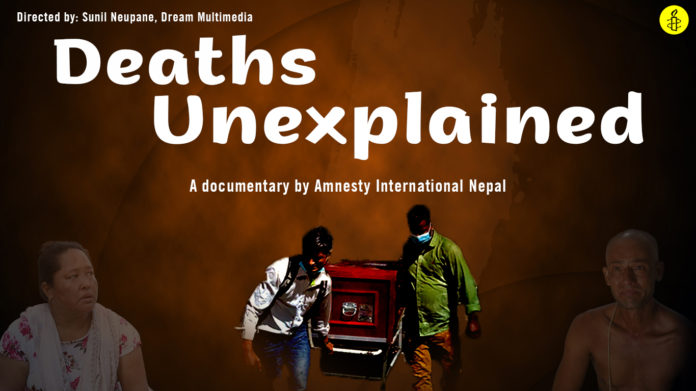
Death Unexplained | Documentary on inadequate investigations of deaths of migrant workers in Qatar

0

This documentary by Amnesty International Nepal highlights how Nepali migrant workers have lost their lives in various destination countries during their foreign employment and how the families suffer without knowing the actual truth of the causes of these deaths many of which are attributed, without adequate investigation, to “natural causes”, vaguely defined as sudden cardiac arrest or heart attack. This has led the bereaved families back home not being able to claim compensation for the loss of their family members.

Open Advice to Mayor Balen

We advise you to think beyond the “engineering model of urban development” and embrace the idea of “social engineering model of development”, which stands for taking into account social, economic, ecological, cultural and human implications of a development initiative.

Dear Mayor Balendra Shah (aka Balen),

We are just recalling how wholeheartedly your electoral victory to the mayoral position of the Kathmandu Metropolitan City was celebrated by people from all quarters in May 2022. Not only the people in Kathmandu but many Nepalis in general throughout the country and abroad had pinned very high hopes on you. 

Though not the voters of Kathmandu, we were among those who had wished for your victory. It was because you, as an independent mayoral candidate, with the demonstrated commitment to serve the people as an elected official, had succeeded to justify your candidacy as a viable alternative to the traditional partition candidates.

After assuming your office, you had made a good start by allowing access to the media to the executive meeting. You went straight on to try and resolve Kathmandu’s long standing solid waste management problems. You also innovatively explored solutions to the crisis of public toilets in different parts of Kathmandu by convincing the private sector to allow public use of their sanitation facilities. You also came up with an idea of “infrastructure ambulance” as a sensible response to the widespread problems of maintenance works.

However, the subsequent decisions and actions of the Metropolitan Government under your leadership have attracted public controversies one after another.

Your intention to restore the Tukucha stream to its natural form was not wrong in itself. But, prior to digging the ground at the Jaya Nepal Cinema Hall, you should have consulted the relevant stakeholders including the Department of Archaeology and conducted a thorough study of the ground-reality of Tukucha in order to understand the viability of its restoration. The unplanned and haphazard attempt unnecessarily embroiled you into widespread criticism.

As a matter of priority, you signed an agreement dated 25 August 2022 between the Kathmandu Metropolitan City and the National Land Commission (a federal entity) to jointly conduct a verification of landless “squatters” and unmanaged dwellers in Kathmandu. That undoubtedly was your legitimate move given the fact that the local government also shares the legal obligation to resolve the problems of landless “squatters” in a sustainable way.

However, you put aside the agreement instead of prioritizing it. You rather went on to respond to the “request” made by the High Powered Committee for Integrated Development of the Bagmati Civilization by mobilizing the metropolitan police authority to bulldoze the habitats of the “squatters” in the Thapathali area. Such attempted bulldozing invited a violent clash between the settlers and the Metropolitan police personnel. 

As the executive head of the Kathmandu Metropolis, you were supposed to think through, learn lessons from the earlier failed attempts and explore more legitimate and sustainable options – including by extending the necessary cooperation to the National Land Commission to complete the verification process promptly, and then to carry out a lawful eviction only after offering a suitable alternative of housing facility to those identified as landless households. 

Instead, your office subsequently wrote a letter to the home minister, requesting for reinforcement of the police to carry out these evictions. This forced, and  by “hook or crook” approach is meant to invite massive human rights abuses the metropolitan and federal government will have to be answerable to. We are not quite sure how the home ministry is responding to your request, but, as a federal authority, the home ministry cannot and must not go against the lawful verification process initiated by the National Land Commission. 

Of course, no law bars the municipal government from carrying out “lawful evictions” for the public purpose. However, you need to be mindful that “unlawful” or “arbitrary” evictions of families from their habitats (which are protected under human rights and humanitarian laws regardless of the informality of the tenure-ship) without offering them adequate alternatives will constitute a serious violation of human rights. The arbitrary notification published in the media by warning the settlers to dismantle the structures they had created and leave the place in no way satisfies the “due process of law” requirement. There should be a proper verification process to bring to the knowledge of the State to ascertain how many families live there because of the need (due to the lack of alternative) and how many have created structures because of their greed (with the intent to amass property). There is no denying that the State cannot and must not serve greed. However, it must serve the needs of its people. If it is not possible for the State to ensure betterment, it must adhere to the “duty to respect human rights” by refraining from arbitrary evictions that render people homeless and thereby deprive them of their source of livelihoods. There is no legal exemption for the municipal government as it is also a part of the State. 

Your unilateral plan to build a three-story underground parking lot in Tundikhel (Khulla Manch), which has become victim of intermittent encroachment by private as well as government actors, has also attracted organized protest from environmental activists and local residents. What went wrong with this was the lack of consultation with the stakeholders.

The story doesn’t end there. The way the Metropolis authorities have been handling the problems of street vending or hawking is hugely problematic from the point of view of social justice. The prohibitory notice issued by your office on 10th January2023 illustrates that you have adopted a “criminal law approach” to deal with street vending and this is unforgiving.

As an integral part of the State, it is of utmost importance for the Metropolitan Government to internalize the truth that multidimensional poverty exists in our society. The poor families haven’t come to do street vending with the intent to create a traffic problem in the city. Rather, they have been doing so as their unavoidable strategy to fulfill their basic necessities in the kind of extreme poverty that they are in. Many of them probably might have chosen to come to the capital city with the objective of providing better education to their children, which in their understanding could be a game changer in their lives.

Street vending should therefore be recognized as a part of our economy. The street vendors are self-employed traders who generate their livelihoods on their own. Their contribution to the efforts of poverty alleviation shouldn’t be underrated. Rather, it should be acknowledged as per Nepal’s commitments to the Sustainable Development Goals.

Your duty as the head of the capital city was, therefore, to think about appropriate alternatives to manage this problem instead of imposing a blanket prohibition. By being a part of the assistance to such citizens, you could evolve as a role model to inspire others.

You could also learn from comparative experiences from around the world. For example, in 2012, the municipal government of Lima In Peru consulted with street vendors and issued an ordinance to manage and formalize the street vending business.

The Supreme Court of India, in the case of Gainda Ram v. MCD, recognized that the “hawkers”, “squatters”or “vendors” have the fundamental right to carry on hawking under Article 19(1)(g) of the Constitution of India. The Court stated that “the fundamental right of the hawkers, just because they are poor and unorganized, cannot be left in a state of limbo” and directed the government to enact national legislation to regulate and protect street vendors.  

Adhering to the Court order, the Government of India enacted the Street Vendors (Protection of Livelihood and Regulation of Street Vending) Act, 2014, which, inter alia, introduces a licensing system to safeguard the vendors from harassment and expulsion.

There are also good examples from developed countries. For instance, the State of California in the USA enacted a law on safe sidewalk vending (Senate Bill 946) in 2018 that decriminalizes sidewalk vending and regulates it. This law acknowledges the contribution of sidewalk vending to the economy by providing important entrepreneurship and economic development opportunities to low-income and immigrant communities and increasing access to desired goods, such as culturally significant food. Reportedly, street vending is a big business in Los Angeles. An estimated 500,000 vendors contribute over USD 500 million in revenue each year.

Having said that, let us stress that you have no luxury to fail. You need to set a positive example for new generations who actually made you the Mayor of the capital city at your young age. You still have ample time to learn to succeed by bringing every initiative to the right track.

The key to your success would be none other than the rule of law. It is supremely important for you to understand laws in their entirety and comply with all applicable laws. The Local Government Operation Act, 2017 is definitely the key piece of legislation for you. However, the local government cannot be lopsided in applying the provisions of this law. While empowering the municipal government to protect and conserve government/ public land or properties, the Act has ample provisions that obligate you to identify and keep record of landless peoples in the respective territory, advance social justice and contribute to alleviating poverty aligned with the promises under the Constitution. The Act should be applied in harmony with the Constitution and other laws (e.g. Right to Housing Act, 2018, Right to Food and Food Sovereignty Act, 2018) enacted to implement the fundamental rights.

Moreover, we advise you to think beyond “engineering model of urban development” and embrace the idea of “social engineering model of development”, which stands for taking into account social, economic, ecological, cultural and human implications of a development initiative.

It is also of utmost importance to avoid double standards. Signing an agreement with the Commission and attempting to bulldoze the settlement areas indiscriminately without completing the verification process is a profound example of double standard. There must be a ‘full stop’ to such an attitude for enhancing the credibility of the mayoral position.

To become a dynamic and smart leader, it would also be important to introspect through, analyze what went right and what went wrong, learn from and gain ability to adjust and change, and be approachable to listen to your constituents including the street vendors and settlers. It is because the real source of your power is trust and confidence of the constituents that you serve.

Finally, we wish all the best that you would revisit your approach and choose to be a dynamic Mayor, who possesses the ability to listen to the “other side” and adjust as appropriate. 

(Chapagai is a constitutional and human rights lawyer and Thapaliya is Director of Amnesty International Nepal)

The Opinion was originally published by myRepublica.

Victimising The Survivors: Sexual Abuse and Weak Laws

0

Nepal needs to revisit its laws on sexual offences. Many Sections in existing laws add more trauma to the survivors and make their access to justice difficult.

On 18 May 2022, a young woman, 24, took to her TikTok and posted a series of videos revealing the horror she has gone through when she was just 16 years old – a minor. She alleged that she was drugged and sexually assaulted by the accused at a hotel in Baneshwor; and that the accused went on to abuse her for next six months. In one of her videos, she questioned the rule of law in Nepal. The ‘Statute of Limitation’ is preventing her from seeking legal remedy. 

While the people were still in shock, protesting the incident and demanding justice for the survivor, another incident from one of the colleges in Kathmandu came to light. The minor students of the college alleged that some teachers have been sexually abusing them.

The law in Nepal requires complaints in rape cases to be filed within one year of the date of the incident, except in the cases of ‘incest’ as provided under Section 229 of the National Penal Code of Nepal. Further, in cases of bestiality and cases where offence is committed against a person held in detention, taken into control, kidnapped or taken hostage, they are required to file a complaint within three months of their release.

The Constitution of Nepal guarantees protection to women under Article 38(3), which reads “No woman shall be subjected to physical, mental, sexual, psychological or other form of violence or exploitation on grounds of religion, social, cultural tradition, practice or on any other grounds. Such act shall be punishable by law, and the victim shall have the right to obtain compensation in accordance with law”. Despite the guarantees provided under the law, thousands of cases of sexual abuses are reported across Nepal every year.

Crime of rape is recognized as a human rights violation and a manifestation of gender-based violence against women and girls that could amount to torture, under the framework of International Human Rights laws and jurisprudence. Further, rape can even constitute a war crime or a crime against humanity under International Humanitarian Law and International Criminal Law.

The year 2077-78 (2021) data, from Crime Investigation Department of Nepal, shows that 2532 cases of rape, 735 cases of Attempt to rape, 281 cases of child sexual abuse and 36 unnatural intercourse cases were registered throughout Nepal, adding to approximately 19% of the total of crime related cases reported in the country. Most of the rape cases were registered in Province 1, followed by Lumbini, Province 2, Bagmati, Sudurpaschim, Gandaki and Karnali Provinces. 227 cases were register in Metro. Similarly, Province 1 topped in cases of child sexual abuse with 77 cases, followed by Bagmati, Gandaki, Province 2, Lumbini, Sudurpaschim and Karnali provinces, while as in Metro 28 cases were registered.

Types of Crime

PROVINCE

Metro

Total

1

2

Bagmati

Gandaki

Lumbini

Karnali

Sudurpaschim

Rape    

602

375

300

209

438

155

226

227

2532

Attempt to rape

167

115

88

56

134

46

89

40

735

Unnatural Intercourse

8

8

1

3

10

1

3

2

36

Child Sexual Abuse

77

35

47

38

34

3

19

28

281

Polygamy

170

108

82

81

131

97

111

72

852

Child Marriage

13

12

9

8

10

19

10

3

84

Witchcraft

4

25

13

2

9

4

4

0

61

Abortion

5

10

1

2

4

1

1

3

27

Untouchability

7

1

2

1

6

4

15

3

39

Domestic Violence

1280

3556

1126

1196

2318

872

1139

2754

14232

Total

2333

4245

1669

1596

3094

1202

1617

3123

18879

Source: Crime Investigation Department (CID)

Looking at the crime data against women and children from last 25 years, there is a significant increase in the cases -particularly rape, attempt to rape and child sexual abuse. The incidents have multi-folded in recent years.

Crime Data against Women and Children

Nepali
Fiscal Year

Year

Rape

Attempt to Rape

Child Sexual Abuse

Polygamy

Child Marriage

Witch Craft

Abortion

Untouchability

Domestic Violence

053/054

1997

112

34

101

5

74

337

054/055

1998

181

34

135

3

101

228

055/056

1999

141

18

96

1

81

432

056/057

2000

186

33

96

5

89

711

057/058

2001

122

35

75

1

55

449

058/059

2002

129

21

51

14

410

059/060

2003

157

18

69

2

15

569

060/061

2004

154

19

44

3

8

922

061/062

2005

188

25

66

1

11

730

062/063

2006

195

38

65

1

14

939

063/064

2007

317

70

94

7

3

1100

064/065

2008

309

73

122

4

13

881

065/066 

2009

391

75

170

2

12

968

066/067

2010

376

101

146

7

4

8

983

067/068 

2011

481

151

197

2

39

12

1355

068/069

2012

555

156

249

12

35

13

2250

069/070

2013

677

245

350

19

28

28

1800

070/071

2014

912

414

421

15

39

18

14

6835

071/072

2015

981

562

518

23

43

17

10

8268

072/073

2016

1089

452

463

20

28

22

19

9398

073/074 

2017

1131

536

464

26

24

22

17

11629

074/075

2018

1480

727

602

59

48

18

18

12225

075/076

2019

2230

786

211

1001

86

46

27

43

14774

076/077

2020

2144

687

232

734

64

34

29

30

11738

077/078

2021

2532

735

281

852

84

61

27

39

14232

Source: Crime Investigation Department (CID)

The Constitution of Nepal, passed in the year 2015, acknowledge women’s rights and provide protection against sexual violence. In 2017, the National Penal Code increased the “Statute of Limitation” from 35 days to one year, besides expanding the definition of rape. The president of Nepal, through an Ordinance in 2020, amended some sections of the law on sexual violence, including imposition of 3-year jail term and fine for those forcing reconciliation or mediation between perpetrators and rape victims or their families. Mediation in such cases usually end up in forced marriage between the victim and the perpetrator, economic influence or the victims being threatened or discouraged to take legal course citing social stigma.

Despite laws being in place, the definition of rape under the National Penal Code is not at par with international legal standards. It does not contain insertion of any other object or any part of the body of the victim or perpetrator, except penile- vaginal penetration. Referring perpetrator as a ‘person’, in the law, covers the offence committed against the women only, putting the offence committed against other genders out of legal jurisdiction. Similarly, though marital rape has been criminalised with a maximum quantum punishment set not exceeding five years imprisonment, the minimum limit is not provided under the law.

Table defining the punishment based on the age:

Age of victimImprisonmentFine/Compensation
Less than 10yrs16-20yrs600,000 NPR
10yrs or above 10 but below 14yrs14-16yrs600,000 NPR
14yrs or above 14 but below 16yrs12-14yrs400,000 NPR
16yrs or above 16 but below 18yrs10-12yrs400,000 NPR
18yrs or above 18yrs7-10yrs200,000 NPR
Marital RapeNot more than five years200,000 NPR

On the basis of the age, physical & mental status of a victim; status and health of the perpetrator and relation between victim and the perpetrator, additional punishment to the perpetrator has been put down in Nepali law under section 219 (6) (7) and (8) of the National Penal (Code) Act 2017.

CircumstanceAdditional Punishment
Committed by person despite knowing he has HIV positiveImprisonment for ten years and one hundred thousand fines
Committed by person who has any other sexually transmitted diseaseUp to three years imprisonment and fine not exceeding thirty thousand
Commission of gang rape Committed on Women who has pregnancy more than six monthsImprisonment for a term not exceeding five years
Committed on a woman who is infirm or disabled or suffering from physical or mental illnessImprisonment for a term not exceeding five years
Committed by showing armsImprisonment for a term not exceeding five years
Sexual intercourse by government employee with detainees or aiding another person to do so.Imprisonment for a term not exceeding three years as well as the additional punishment if such act is penalized by other law.
Sexual intercourse with person in one’s own protection or security or custody; by office-bearer or employee of any organization providing treatment or rehabilitation services to persons of unsound mind or suffering from physical or mental illness held in such organization.Imprisonment for a term not exceeding three years as well as the additional punishment if such act is penalized by other law.
Sexual intercourse by employee serving in a government office or private office or person providing any professional service or commercial work with a person serving in such office or a person making contact or being in contact for such service or work, while performing functions of such office or providing such service or at the place where such service is provided or aiding another person to do so.Imprisonment for a term not exceeding four year and a fine not exceeding forty thousand rupees as well as the additional punishment if such act is penalized by other law.

One of the major issues being faced by the survivors of sexual assault that impedes their access to justice is “The Statute of Limitation”, despite the Government of Nepal amending the law and enhanced the reporting period of the complaints from 35 days. The existing laws and justice system on sexual assaults are not only inconsistent with international standards and the directives issued by the Supreme Court of Nepal, but lack victim-centric approach. The short and long psychological impact of such horrific crimes on the survivors need to considered while drafting laws. Sometimes a survivor takes years together to come out of trauma associated with it, which primarily include depression, PTSD, flashbacks, borderline personality disorder, dissociative identity disorder, self-blame, distrust of others, anger, powerlessness, etc. If the perpetrator is a relative, it not only adds up to trauma and threat but, also, makes it difficult for the survivors to report.

The Supreme Court of Nepal, in the case 3393 of the year 2004; Date of Order 11/07/2008, under Decision No. 8038, has clearly stated;


“The period of limitation stipulated in Section 11 under the Chapter of Rape is insufficient and causes obstacles in providing justice to victims. In order to carry out effective investigations that consider the gravity of the crime and its subsequent persecution, we must recognise social psychology, the amount of time consumed during the investigations, and the victims’ access to justice. A directive order is hereby issued in the name of the Government of Nepal to reform the period of limitation stipulated in Section 11 in the Chapter of Rape”.

Like other countries, a number of sexual assaults cases in Nepal remain unreported due to social stigma, shame, trauma, fear, stigma and intimidation associated with it, besides patriarchal monopoly. The survivors who gather courage and come forward to report the offence do face legal challenges because of weak legal framework, e.g., the statute of limitation, no provision for sexually abuses children to report after reaching adulthood, etc.

The existing Nepali law do not prohibit introducing evidence of the past sexual history of survivor during the trial process in rape cases. It not only affects their legal cases but also shakes their dignity, victimise them further and leaves them vulnerable. Non-existence of a law prohibiting such practice only help the perpetrators escape the law itself.  In Nepal, cases of sexual offences often go unreported. If reported, the prosecutions are rare; if prosecuted, proceedings are rarely pursued in a gender sensitive manner leading to nominal convictions. The survivors are often victimized and re-victimized and the offender celebrates impunity.

Nepal witnessed a decade long armed conflict, between 1996 and 2006. During this period a number of human rights violations and abuses took place, including rapes. In 2014, the Government of Nepal adopted a Truth and Reconciliation Commission Act, 2014 (TJ Act) to criminalize rape a serious human rights violation. The National Penal (Code) Act 2017, however, does not criminalize rape as war crime or crime against humanity. In 2018, the Truth and Reconciliation Commission acknowledged 322 cases of conflict related sexual violence. The commission, however, has been recommending amnesty to offenders, including the perpetrators of rape. The statutory limitation further alienates the rape survivors of armed conflict and makes access to justice and reparation difficult for them. While other South Asian countries like India, Pakistan and Maldives have discarded statute of limitations for lodging the complaint of rape, Nepal is still lagging behind.

There is a dire need to revisit and reform the existing laws on sexual violence in Nepal. The existing system is not only making it difficult for the survivors to report and have access to justice, but it is helping the perpetrators in evading the law and encouraging them to abuse and violate more. Some of the articles that need immediate focus include bringing definition of rape in line with international legal standards, provision for gender neutrality for victims and perpetrators, removing ‘The Statuary Limitation’ all together – including conflict-time victims of sexual violence, prohibiting past sexual history of survivors in their legal cases, making rapes committed by state actors as offence of torture. Protection of victims and witnesses and removing impunity to armed forces personnel in the cases of sexual assaults.

“Standing behind predators makes prey of us all.” 

निहित स्वार्थले संस्थागत जोखिम बढाउँछ: पूर्व अध्यक्ष चरण प्रसाईं

0
एम्नेस्टी इन्टरनेसनलका अन्तर्राष्ट्रिय कार्यकारी समितिका अध्यक्ष रोश डेनियल्सलगायत पाँच सदस्यीय प्रतिनिधि मण्डलद्वारा सन् १९९६ मा तत्कालीन राजा बिरेन्द्र बीर विक्रम शाहसँग राजदरबारमा भएको भेट।

बिपिन बुढाथोकीको नयाँ बोर्डको सबल नेतृत्वले विगतका गल्तीहरू दोहोरिन दिनेछैन।

एकजना बेलायती वकिल पीटर बेनन्सनले सन् १९६१ मे २८ मा शुरू गरेको एम्नेस्टी यात्रा अहिले विश्वभर झाँगिएको छ। अन्यायपूर्वक जेल-नेल भोग्न बाध्य भएका नागरिकहरूको ‘रिहाइ’ को अपिल गरी ‘दि अबजर्भर’मा ‘फर्गटन प्रिजनर्स’ (बिर्सिएका बन्दी) बारे एक लेख उनले प्रकाशित गरेका थिए। पोर्चुगली दुई नागरिकलाई पात्र बनाएर लेखिएको त्यस लेखले विश्वको ध्यान खिच्यो। यसबाट शासकहरूले बिना कसुर नागरिकलाई कसरी बन्दी बनाउँदा रहेछन् भन्ने खुलासा भयो। ‘रिहाइ’का लागि विश्वभरको पत्राचार अभियान यसबाट थालनी भयो। सम्बन्धित सरकारहरूलाई शक्तिको दूरुपयोग नगर्न र जवाफदेही बन्न यस संस्थाले मुख्य भूमिका यस अभियानदेखि नै खेल्दै आएको हो।

नेपालमा आदरणीय नुतन थपलियाले सन् १९६९ मा स्थापना गर्नु भएको यो संस्था संस्थापक अध्यक्ष ऋषिकेश शाहदेखि बिपिन बुढाथोकीको कार्यकालसम्म आइपुगेको छ। यसले ५३ वर्षको अवधिमा निकै उतार चढाव ब्यहोर्नु पर्यो। सन् १९८२ मा अन्तर्राष्ट्रिय स्तरबाट विघटन भएको यो संस्थाले बहुदलीय प्रजातन्त्रको पुनःउदय सँगै चित्र निरौलाको संयोजकत्वमार्फत नेपालमा नयाँ जीवन पायो। यस पछिका ३२ वर्षका यात्रामा पनि यो त्यति सरल रेखामा हिँडेको पाईंदैन।

सन् १९९६ मा म यस संस्थाको अध्यक्ष भएँ । त्यसबेला यस संस्थामाथि बाह्य तत्वबाट मात्र खतरा रहेको मेरो बुझाइ थियो। अमुक विदेशी राजदूतावासबाट आर्थिक प्रलोभन तथा धम्कीपूर्ण संदेश प्राप्त भएका घटना बारम्बार सुन्ने गरिन्थ्यो। तत्कालीन बागबजार कार्यालयमा केही व्यवसायिक गुण्डा आएर अध्यक्षलाई मार्ने धम्की दिएको प्रशंग पनि सुनिएको थियो। सन् १९९६ मा चीनमा भएका मानवअधिकार उल्लंघनका घटना सम्बन्धमा एम्नेस्टीले ‘चीनमा कोही सुरक्षित छैनन्’ भन्ने विश्वव्यापी अभियानले नेपालमा कस्तो असर पर्ला ? सबैेको चासो थियो।

संस्थाको नेतृत्व सम्हालेपछि यस चुनौती समेतलाई स्वीकार्न मेरो बोर्ड तयार भयो। सचिवालयले साथ दियो । यस अभियानका विभिन्न चरणहरूमध्ये १८ मार्च दिनको दुई बजे काठमाडौंको नेपाल वायुसेवा निगम कार्यालय अगाडीबाट चिनिया दूतावाससम्म जुलुसयात्रा गर्ने सार्वजनिक कार्यक्रम राखियो। तर त्यस दिन जुलुस शुरू नहुँदै पक्राउमा पर्यौं र काठमाडौं पुलिस क्लबमा हामीलाई लगियो। हामी २० जनालाई त्यहाँ पुर्याईँदा करिब ३०० तिब्बती शरणार्थीलाई पक्रेर त्यहीँ ल्याइएको रहेछ राजनीतिक रंग दिन।

यसबाट एम्नेस्टीको विशुद्ध मानवअधिकार अभियानलाई ‘फ्रि टिबेट’ आवरण दिने कोसिस भयो। प्रायः सबै मिडियाले यसैगरी समाचार सम्प्रेषण गरे। तर एम्नेस्टीलाई परेको यस कठिन घडीमा एक विदेशी नागरिक बार्बरा एडम्सले ‘दि राइजिङ नेपाल’ मा ‘इन फेवर अफ एम्नेस्टी’ रचना लेखेर यस अभियानको बचाउ गरिन्। मेरो साधारण चिनजान भएपनि राज्यद्वारा रचित षडयन्त्र विरुद्ध उभिने उनले हिम्मत कसिन्। उनको त्यो लेखले ‘हाम्रा शुभचिन्तक पनि छन्’ भन्ने ढाडस पाएको भान भयो। हनुमान ढोकाको १० दिनजतिको गैरन्यायिक थुनामा बस्दा। सन् २०१६ अप्रिल २२ पछि भौतिक उपस्थिति उनको नरहे पनि एम्नेस्टीको दुःखको मित्रका रूपमा उनलाई संधै संझनुपर्छ जस्तो लाग्छ।

यस घटनाले विश्वको ध्यान तान्यो। हामीलाई हनुमानढोकामा रातिको १२–१ बजे तिर थुना सारियो। हाम्रो रिहाइका लागि विश्वभरका एम्नेस्टी सदस्यले पत्रचार गरे ‘आस्थाका बन्दी’का रूपमा। चीन सरकारको अनौपचारिक हस्तक्षेपका समाचार सार्वजनिक भएपनि नेपाल सरकारले विश्वबाट उर्लिएको पत्र दबाबलाई थेग्न सकेन। चीनमा बलपूर्वक फिर्ता पठाउन छनौट भएका १४ जना तिब्बती नेताहरू र हामीलाई रिहाइ गर्न तत्कालीन देउवा सरकार बाध्य भयो।

यस घटनाको केही महिनापछि नेपालले ‘एसिया प्यासिफिक अन्तर्राष्ट्रिय सम्मेलन’को आयोजना गर्नुपर्ने थियो। यस असहज परिस्थितिमा कार्यक्रम हुनसक्ने अवस्था थिएन। सरकारले यसलाई रोक लगाउन सक्ने बुझाई अन्तर्राष्ट्रिय समुदायको थियो। तर कार्यक्रम हुनुपर्नेमा हामी दृढ थियौं। तत्कालीन प्रधानमन्त्री शेरबहादुरलाई भेट्यौं र उनलाई प्रमुख अतिथि बनाउने गरी कार्यक्रम बनायौँ। अन्तर्राष्ट्रिय प्रतिनिधि आए। उद्घाटन कार्यक्रममा देउवाका साथै आस्थाका बन्दी एवं पूर्व प्रधानमन्त्री कृष्णप्रसाद भट्टराईको पनि विशेष अतिथिका रूपमा उपस्थिति थियो। परराष्ट्रमन्त्री प्रकाशचन्द्र लोहनी यसैको एक छुट्टै कार्यक्रममा प्रमुख अतिथि वक्ता थिए। प्रधानमन्त्री देउवाले एम्नेस्टीका अन्तर्राष्ट्रिय नेतृत्व तथा सचिवालय प्रतिनिधिसँग अलग्गै भेट गरेका पनि थिए।

सम्मेलन चल्दै गर्दा तत्कालीन राजा बिरेन्द्र बीर विक्रम शाहले पनि एम्नेस्टीका अन्तर्राष्ट्रिय अध्यक्ष रोश डेनियल्स लगायतका पाँच सदस्सीय प्रतिनिधि मण्डललाई राजदरबारमा भेट दिए। एक घण्टाभन्दा बढी समयको त्यस भेटमा खासगरी मृत्युदण्ड उन्मुलनको विषय उठाइएको थियो। किनभने २०४७ को संविधानले मृत्युदण्ड उन्मुलन गरेपनि राजदरबारसम्बन्धी कानुनमा यो प्रावधान जीवितै थियो। यसको खारेजीको लागि राजाको पनि सहमति चाहिन्थ्यो। खुला रूपमा भएको उक्त छलफलमा राजा बिरेन्द्रले ऐनमा भएको ती प्रावधान हटाउन पूर्ण सहयोग गर्ने वचन दिए। सायद राजासँग एम्नेस्टीको यो पहिलो भेट थियो।

सबैले चासो राखेको यो सम्मेलन सफल भएको कतिपय सदस्यहरूलाई मन नपरेको रहेछ। त्यसैले केहीले यसबाट आन्तरिक कलह उब्जाउँने बाटो बनाए। प्रधानमन्त्रीसँंगको भेटमा किन अमुक व्यक्ति परेनन्? जस्ता झिना सवाल उठाए। अर्थात जिम्मेवार व्यक्तिहरूबाटै संस्थाभन्दा व्यक्ति स्वार्थका यस्ता सवाललाई द्वन्द्वका मुद्दा बनाइएको थियो। त्यसपछिका दिनहरूमा तत्कालीन महासचिव त्यसपछि निर्देशकले दिएको राजिनामाबाट असहयोगका यात्रा शुरू भएको देखिन्थ्यो।

तर विडम्बना अहिले पनि व्यक्ति कन्द्रित जोखिम एम्नेस्टी नेपालमा विद्यमान छ। मेरो अनुभवमा एम्नेस्टीमाथिको खतरा आन्तरिक तहबाटै बढी छ। कसैको स्वार्थसँग अस्थिरता गाँसिएको देखिन्छ। किनभने सन् २०१५ मा एम्नेस्टीलाई बन्द गर्ने प्रपंच रचिएको कुनै “प्रभावशाली” व्यक्तिको स्वार्थ बाझ्दाको परिणाम थियो। सन् २०२१ मा समेत यो खतरा दोहोरिन खोजेको थियो। तर बिक्रम ढुकुछु बोर्डको विवेक र सुझबुझले त्यो टर्यो। मलाई लाग्छ बिपिन बुढाथोकीको नयाँ बोर्डको सबल तथा सुझबुझपूर्ण नेतृत्वका साथ विगतका गल्तीहरू दोहोरिन दिनेछैन।

एम्नेस्टी दिवसको हार्दिक शुभकामना ।

Nepal must remove statute of limitations on cases or rape and sexual violence: Amnesty International

0

Originally published by The Kathmandu Post.

Nepal must remove statute of limitations on cases or rape and sexual violence: Amnesty International

Nepal must urgently remove the statute of limitations on cases of rape and other sexual violence through amendments as it continues to be a barrier for survivors in access to justice, Amnesty International said on Thursday.

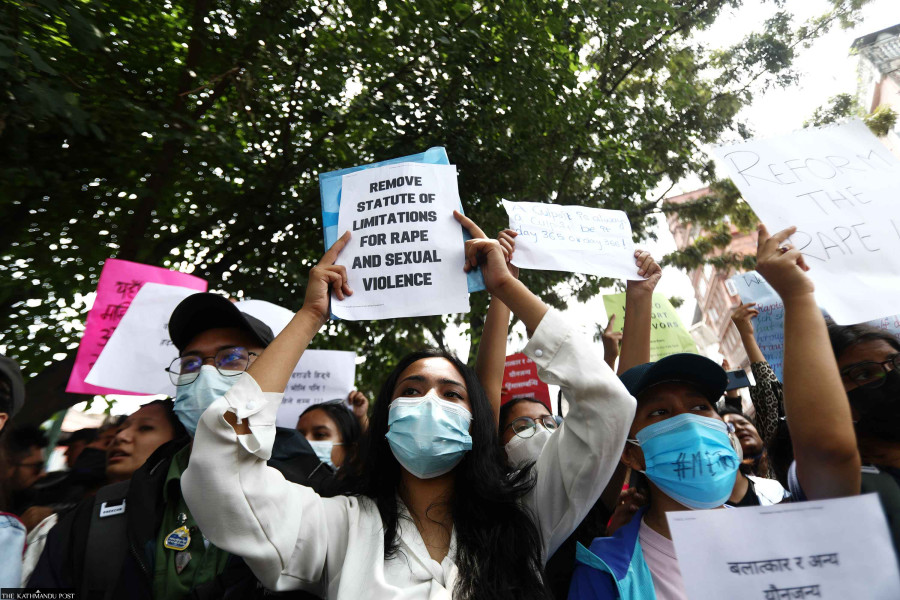
Issuing a statement, the international human rights organisation has also expressed its solidarity with the ongoing protests demanding swift justice for victims of sexual violence and reform of rape laws in Nepal.

People have been taking to streets ever since an aspiring model on May 18 took to social media to share her harrowing experience of rape for months eight years ago at the hands of Manoj Pandey, a pageant organiser. She was 16 at that time.

Under the 2017 penal code of Nepal, complaints of rape must be filed within one year from the date of the crime. And this statute of limitations has become a barrier to justice for survivors.

“This is grossly restrictive as it prevents many victims from accessing legal remedy effectively, in particular, victims of child rape,” reads the statement.

Amnesty International says the grossly restrictive and inadequate length of limitation fails to take into account the stigma that women and girls face when reporting cases of sexual and gender-based violence and prevents them from accessing legal remedy, therefore, fosters impunity for such crimes.

“Time and again we have seen courageous survivors are denied justice because of the outdated and harmful one-year limit for filing rape complaints. The current provision is grossly restrictive, unfair and unmindful of the state the survivor might be in. In its current form, such provisions allow many perpetrators of rape to get away with their crimes,” Yamini Mishra, South Asia Regional Director for Amnesty International, is quoted as saying in the statement.

In 2008, the Supreme Court of Nepal issued a directive asking the government to amend laws to adequately expand the then 35 days of statute of limitations taking into consideration the victim’s psychological status, time required for investigation, and the existing barriers to justice.

The provision of a one-year statute of limitations in the new 2017 penal code remains insufficient and continues to deny legal remedy for victims who file complaints after one year.

In 2008, the United Nations Office of the High Commissioner for Human Rights (OHCHR) representative noted that “the statutory limit is often used as an excuse by police for not filing a complaint in cases of rape.”

“The government must take swift measures to review the legislation to bring it in line with international standards, including ensuring gender neutral references in the law for perpetrators and victims,” said Mishra. “Authorities must also ensure prompt investigations and prosecution of allegations of rape and other sexual violence and sufficient access to justice and reparations for the survivors while ensuring their protection during the investigation and trial.”

“ The authorities in Nepal must not ignore the demands of women’s rights activists for this important change to strengthen survivors’ rights in the country,” Mishra added.

Amnesty Nepal elects new National Board, Appeals Committee for a term of two years

0

Originally published by Republica on  April 5, 2022.

Amnesty Nepal elects new National Board, Appeals Committee for a term of two years

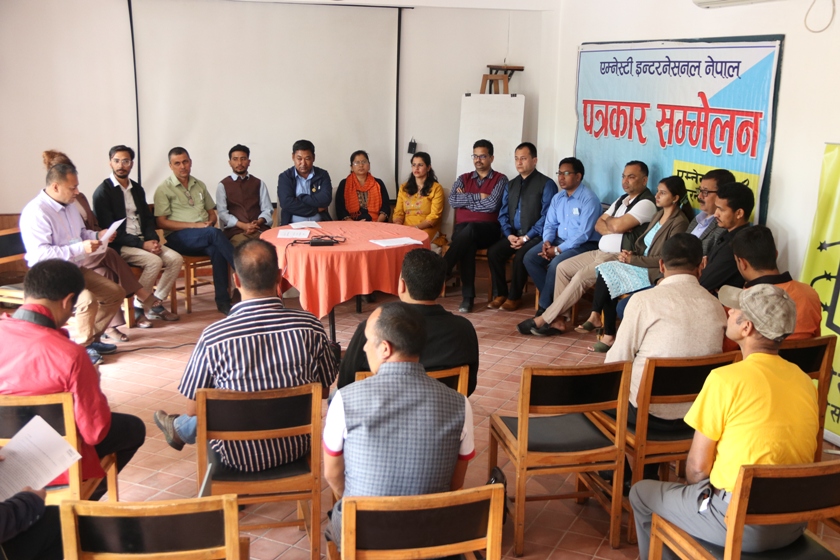
KATHMANDU, April 5: Amnesty International Nepal (Amnesty Nepal) has concluded its 30th General Meeting in Dhulikhel Metropolitan City, Kavre, electing a new leadership for its National Board and an Appeals Committee for a term of two years.

The newly-elected National Board constitutes Bipin Budhathoki as the Chairperson and Roshan Bajgain as the Treasurer. The members of the board include Sachita Kuikel, Bimala Wagle, Manju Bishwakarma, Keshav Pokharel, Nikhil Pokharel, Hom Bahadur Adhikari, Devendra Sejuwal, Garima Pandey and Barun Kuikel. The newly-elected Appeals Committee constitutes Jivan Prasad Phuyal as the Coordinator, and Laxmi Regmi and Lokendra Singh as its members.

The general meeting held earlier this week also passed its annual reports, work plans, budget and some policy documents, according to a press statement issued by Amnesty International.

Over 300 participants including 254 voting delegates from Amnesty Nepal’s groups, youth networks and the constituency of supporter members across the country and its Board and Appeals Committee officials, staff, volunteers, observers, and delegates from the international secretariat attended this general meeting.

Speaking at the inaugural event, Chief Guest Balram KC, a former justice of the Supreme Court, expressed his concerns over the lack of the government’s accountability in ensuring justice to the victims of rape incidents, which have remained unabated in the country.

Suman Adhikari, founder of Conflict Victims Common Platform, urged Amnesty Nepal members to work proactively in holding the government accountable in the cases of human rights violations during the conflict and ending the state of impunity.

In her video message, Dr Anjhula Mya Singh Bais, Chair of the International Board of Amnesty International, expressed her commitment in providing necessary support of the International Board and the International Secretariat to further strengthen Amnesty’s human rights movement in Nepal. 

“Through a democratic process, Amnesty Nepal elected a new leadership,” Amnesty International Nepal Director Nirajan Thapaliya said. “The newly-elected board is inclusive with the representation of youths, women and marginalized communities.”

 The newly-elected bodies include an eleven-member National Board of Amnesty Nepal led by 26-year-old Bipin Budhathoki while a three-member Appeal Committee led by Jeevan Prasad Phuyal.

“Continuity of Amnesty Nepal’s governance reform process for a clear, strong and effective human rights movement through new strategic goals will be the mandate for us,” Bipin Budhathoki, newly-elected Chairperson of Amnesty International Nepal, said.

The human rights situation in Nepal is still far from satisfactory: Amnesty Nepal Director Nirajan Thapaliya

0

‘Unless we keep laws above anything else, above anybody else, including even the most powerful in the country, the fight for ending impunity will continue to remain a mirage.’

Amnesty International at the global level is the largest human rights organization with over 10 million members and supporters. Amnesty International Nepal (Amnesty Nepal) is one of the 69 Sections of Amnesty International. Nepal is the only country in South Asia where there is a Section of Amnesty International.

Amnesty International Nepal has been continuously advocating, fighting for and raising awareness among people for the protection of human rights, including the rights of the citizens.  However, Nepal’s human rights situations are far from satisfactory, according to Amnesty International’s recent report. In this context, Nepal Live Today caught up with Nirajan Thapaliya, Director of Amnesty International Nepal, who has the experience of working as a human rights officer with the United Nations Office of the High Commissioner for Human Rights in Nepal, UNDP and other I/NGOs, to discuss various aspects of human rights situations in Nepal, the evolution of Amnesty International Nepal and its vision and priorities for the days to come.

To start off, can you tell us how Amnesty International Nepal was born? How did this organization evolve? 

Well, it’s a long story. Amnesty International, as the largest human rights movement, was started by a very few conscientious individuals in 1961 who took injustices suffered by others deeply personally. A British lawyer Peter Benenson, who was outraged to read the news of seven years’ imprisonment to two young Portuguese students simply for toasting to freedom, wrote an article entitled “The Forgotten Prisoners” in The Observer calling the world population to join what was then called the “Appeal for Amnesty” campaign launched to secure the release of all those who were unjustly detained or imprisoned merely for who they were and/or for what they believed in.

In Nepal, it was Nutan Thapaliya, who in 1969 conceived the idea of bringing the activism of Amnesty International to Nepal after having met some of its founders in London. It was a time of oppression and restriction with the then Panchayat regime severely cracking down on people’s right to freedom of expression, dissent and political activism in Nepal. Several hundred political activists were languishing in jails simply for believing in or subscribing to a political faith or ideology. Several political activists who later became Nepal’s renowned leaders—BP Koirala, Rup Chand Bista, Girija Prasad Koirala, Sher Bahadur Deuba, Modnath Prasrit, Ganeshman Singh, Krishna Prasad Bhattarai—were then Amnesty’s prisoners of conscience a term Amnesty uses for those who are arbitrarily imprisoned, often incommunicado and without fair trials, for who they are or what they believe in.       

One of the events in 1990 where Amnesty members in Nepal were talking about the revival of the Amnesty section in Nepal.

Although Amnesty activism was brought in Nepal in 1969, Amnesty Nepal was recognized as a Section of Amnesty International only in 1972. Founder Nutan Thapaliya and the Amnesty supporters in Nepal had jointly agreed to choose former foreign Minister Rishikesh Shah as the first Chair of Amnesty Nepal. He was later arrested in May 1977 on sedition charges. Due to extremely difficult civic space including a heavy crackdown on freedom of expression, opinion and assembly, and other internal difficulties, Amnesty could not survive as a Section for long. It was dissolved in 1982 by the international executive committee. The members and supporters of Amnesty in Nepal, however, continued their activism in whatever form and manner was possible in the context.    

Following the restoration of democracy in 1990, Amnesty supporters in Nepal regrouped, and with support from the international secretariat, a coordinating structure was formed. The Amnesty movement in Nepal was again recognized as a Section in 1993. Since then, Amnesty Nepal continues to function uninterrupted. 

As a human rights movement and organization, Amnesty Nepal is the oldest and first in the country. It is therefore also often known as a school for human rights activism in Nepal. Many members and supporters who were part of this movement went on to serve prominent roles in the government and intergovernmental organizations. Amnesty Nepal’s founder Nutan Thapaliya was elected as a member of the UN’s Committee on Economic, Social and Cultural Rights in the 1990s. It was also in the early 1990s that Nepal ratified most of the core UN human rights treaties for which Amnesty Nepal played a big role. 

That sounds pretty inspiring. What are some of the challenges or the hard times the AIN faced in the course of its journey? 

Organizations, once they are born, grow very much like living things. They have their highs and lows and their ups and downs. Amnesty Nepal is no exception. When Amnesty Nepal was a Section in the 1970s, the difficult civic space including severe restriction on free speech, expression, assembly and association had a heavy toll in its existence as a Section. 

When it emerged as a Section in the 1990s, Amnesty Nepal grew, expanded and achieved great results. As a people-powered movement based in Nepal, Amnesty Nepal also truly reflects the Nepali society—the polarizations, the factions, the diversity of opinions, the differing viewpoints and differing thought processes including vestiges of feudal and patriarchal mindsets. One of the ills that plagued Amnesty Nepal as it grew in the first decade of the second millennium was that its governance was heavily controlled, dominated and manipulated by a handful of people. There often emerged confusion and tussle between the governance and operational aspects of the organization. The lowest moment in the life of Amnesty Nepal was in 2015 when nine of its executive board members resigned under heavy pressure from one of its former Chairs who wrongly, and in a personalized way, took offense with Amnesty’s human rights based call to follow due process, and respect the right to life and dignity of a dissenting political leader who now heads a mainstream political party. 

Amnesty Nepal continues to evolve from such crises, learning, growing and becoming bigger, bolder and more inclusive each day. Amnesty Nepal is also reforming its decision making processes as it grows. In September 2021, a Special General Meeting amended its Statute to include members from its Youth Networks and the constituency of Supporter/Individual members, who constituted half of its nearly eight thousand members, in its decision-making processes including the General Meeting. 

On April 1 and 2 this year, Amnesty Nepal concluded its 30th General Meeting in Dhulikhel, Kavre electing a fairly inclusive Board headed by the youngest ever Chair not just of the Section in Nepal but of the entire Amnesty movement in the world. 

What are the priority areas of work of Amnesty International Nepal? 

Amnesty’s major campaign in the early phase of its inception was to secure the release of the political prisoners and “prisoners of conscience”. Amnesty later started working on a campaign against death penalty. Then on a campaign against torture. It was awarded the Nobel Peace Prize in 1979 for its defense of “human dignity against torture”. It was also awarded the UN’s Human Rights Award in 1978.   

Although Amnesty focused its human rights interventions in the areas of civil and political rights in its early phase, Amnesty now works on a “full spectrum” of human rights issues ranging from civil and political rights to economic, social and cultural rights (ESCRs) to rights of minorities, disadvantaged and the historically oppressed and marginalized groups. 

In Nepal, our priority areas of intervention and engagement include issues related to both civil and political rights and economic, social and cultural rights. Freedom of expression, opinion, association and assembly, also known as the civic space is an area where we keep our focus. We also continue to work in collaboration and partnership with the victims’ community in Nepal to press for their rights to truth, justice and reparations. We also focus on issues around gender and intersectional justice. We raise our voices to end all forms of discrimination, violence and injustice against women, children, minority groups, Dalits, indigenous people, marginalized and the LGBTIQ+ community.

Access to land, housing, food, health and social security are critical human rights issues in Nepal, and we continue to work on these issues bringing factual realities to the fore and recommending measures the government should undertake to address the gaps. Rights of the migrant workers has remained a long-standing issue in Nepal as Nepali migrant workers suffer abuses and injustices both at home from domestic recruiters, and at the destination countries at the hands of their employers and the abusive, hostile and unfriendly system. Several research and campaign works we have generated since 2010 call for the government to regulate the foreign employment recruitment practices, ensure and facilitate access to justice to the victims and hold accountable those found guilty of abusive practices.   

Climate change is now becoming a serious human rights issue as it is already disproportionately affecting the most marginalized and vulnerable people in Nepal. Due diligence and a human rights based approach should be the key to any mitigation and adaptation measures that the government undertakes. This is a challenging area of work and we keep our eyes open. 

How does Nepal compare with other countries in the region in terms of safeguarding the rights of the citizens?

Nepal is comparatively a freer society in the South Asian region. Since the restoration of democracy in Nepal in 1990, we have achieved good progress in terms of freedom of expression, opinion, assembly and enjoyment of our basic civic liberties. However, the enjoyment of the economic, social and cultural rights continues to be a longstanding issue due to several factors including systemic poverty, inequality, discrimination and exclusionary practices so rampant at various levels of our governance and societal order. The political upheavals and changes have no doubt brought about a great level of awareness among people, but the State has yet to undertake several legal, policy and infrastructural initiatives to fulfil these rights. The Constitution of Nepal 2015 is fairly progressive and rights-friendly as it guarantees a broad range of fundamental rights. The duty to “respect, protect and fulfill” these rights rests on the government. 

How does AI Nepal collaborate with the government agencies while carrying out its works?

Everything we do is transparent. We are registered with the district administration office, and the Social Welfare Council (SWC) where we submit our annual work plan, budget, impact reports, and audited financial accounts. The SWC undertakes periodic monitoring of our activities, governance and overall organizational health. 

We announce and make public all of our reactive actions including by informing the authorities in writing. For example, if we are to organize a rally, we pre-inform the local administration, wherever that may be, of our plan including the route of the rally and the expected number of participants.

When we undertake research on a particular human rights issue, we invariably speak to the government stakeholders listening to their perspectives, trying to identify obstacles, gaps and measures required. Before we make our researches public, we consult with the government stakeholders regarding our findings, conclusions and recommendations. We may also accommodate some of their inputs if that does not defeat the very purpose and objective of the report. 

Once our reports are launched, we also keep engaging with the government stakeholders through various campaigns to pressurize and influence them to act towards taking measures to address the problems identified in the research report.  

Amnesty International’s recent report shows that Nepal’s human rights situation is rather bleak. What contributed to this situation? 

The human rights situation in Nepal is still far from satisfactory due to various reasons. Nepal suffers from a systemic problem of impunity, bad-governance and corruption. This has given way to a poor state of rule of law, and the weakening of public institutions which otherwise should have served as the guarantor of people’s rights. The gap between the haves and have-nots is rising. Access to justice is a longstanding issue. There is no easy, fair and equitable access to basic services such as health, education, housing and food. To make it worse, there is also a huge gap between what the government commits to do and what it actually delivers. Inadequate or flawed laws, regulations, policies are one thing but the bigger problem is basically non-implementation or poor implementation of whatever measures are already in place. 

According to your findings, what are the key areas in which the government has failed to safeguard the rights of the citizens? 

The government has failed the victims of conflict by delaying and diluting their calls for truth, justice and reparations. The victims of enforced disappearances have been waiting for over 20 years simply to know the truth of what happened to their loved ones. The government has also failed the poor, marginalized and disadvantaged community in Nepal. The landless squatters and informal settlers continue to live under constant fear of forced eviction. The daily wage earners and migrant workers suffered the biggest brunt in the aftermath of the economic crisis from the Covid pandemic. The government is yet to take steps to address deep economic inequalities including by creating job opportunities within the country. The climate crisis is further aggravating this situation by disproportionately affecting the people in the margins. 

Your organization also works to safeguard the rights of the refugees in Nepal. What is the status of refugees in Nepal? 

Amnesty International launched a global campaign called “I Welcome” from 2016 until the end of 2019. The aim of this campaign was to generate public pressure on governments who had turned increasingly hostile towards refugees and migrants fleeing their homelands for safety and better lives. The campaign achieved some good impacts in creating safe and legal routes for refugees, and in mobilizing public opinion across the globe. Amnesty continues to build on this work in the existing context of global pushback against migrants and refugees. 

Nepal currently does not have a huge volume of refugees as does Poland due to the ongoing crisis in Ukraine or Bangladesh due to the Rohingya crisis. But we did have a similar scale of crisis in the 1990s when hundreds of thousands of Bhutanese were chased away from Bhutan. The Bhutanese refugee problem is now more or less addressed with the third country settlements although some outstanding cases continue to remain. Nepal also hosts several thousand Tibetan refugees who arrived in Nepal in the aftermath of the Chinese takeover of Tibet in 1959. 

Refugees from some African countries, and lately from Myanmar have also arrived in Nepal. These refugees face a lot of challenges as they are here without any legal status, and are forced to work and sustain under harsh and exploitative conditions. 

Nepal has not yet ratified the 1951 Convention Relating to the Protection of Refugees and its 1967 protocol, which we call on to ratify. 

What are the key barriers to the protection of citizens’ rights in Nepal? How can those barriers be broken? 

There are several barriers. Some of these have been touched upon above. Impunity for instance. Weak rule of law, and weakening state institutions plagued by extreme political interventions are not helpful in securing and safeguarding people’s rights. We should also talk about the structural barriers such as the kind of societal set-up we have in Nepal with deep patriarchy and feudalistic mindset. Poverty, inequality, exclusion and historical injustices are yet to be properly addressed.

Systemic reforms of public institutions by allowing them full autonomy and independence with accountable governance is a way to move forward. The State should also walk the talk rather than pay lip service in terms of translating the constitutional guarantees to its citizens on an equitable basis. A mapping of comprehensive action plans with adequate resources to lift the people out from systemic poverty and inequality could be a step towards this. In addition to the constitutional “paper guarantee”, there should also be an enabling environment for people to claim, access and enjoy their rights. 

Nepal has a number of legal instruments to safeguard the rights of the people. But often those legal instruments remain unimplemented. Where is the gap? 

Nepal has ratified seven of the nine core international human rights conventions and their additional protocols. According to Nepal’s Treaty Act 1990, the provisions in these instruments are enforceable “as good as laws”. Nepal has also taken quite a progressive domestic legal arrangements including through the constitution to safeguard the rights of peoples. Where the problem lies, as you rightly say, is in the lack of their honest implementation. The institutional drawbacks including lack of capacity and resources is one thing, extreme politicization is another thing. This has often led to lax commitments on the part of the political leadership and a lethargy and disenchantment on the part of the bureaucracy to not only work on the implementation frameworks such as the delegated legislations, regulations, procedures, and guidelines but also to sincerely design and implement programmatic interventions that give effect to these instruments. So, things need to be looked at holistically. It’s not only about fixing laws and policies, it’s also about fixing behaviors, mindsets, practices and value systems.  

What are the key areas of work for your organization in the days to come? 

There are several areas that we will potentially focus our attention in the days to come. We will continue our advocacy and interventions to address the culture of impunity in Nepal that is at the root of many of the human rights problems in Nepal. This relates to serving truth, justice and reparations and holding accountability not just on the human rights violations committed during the conflict but also on those that were committed before and after the conflict in Nepal and on those that continue to happen. We have to remember and serve justice to the victims of all past violent incidents in Nepal. Khoku Chhintang and Sukhani victims for instance, or the victims of Gaur massacre, or those of the Madhes aandolans. There were several extrajudicial killings committed by the state security forces particularly in the Tarai region in the name of curbing armed groups there which the UN’s Office of High Commissioner for Human Rights and others have very well documented. Justice needs to be served in each of these cases. Only then can we think of a system based on rule of law, equality before law and the equal protection of all by the law. 

Practice of torture is still the area where Nepal should improve. We have cases of several deaths in custody even today. How these deaths happen in the safety and protection of state guards is mysterious. Police usually say these deaths are the result of suicides. But how can suicides be possible under the eyes and ears of the state? If they happen, then it’s the state’s weakness or rather the state’s incitement or abetment. 

Gender and intersectional justice is another area where we will continue our focus. Discrimination, violence, intolerance and homophobic behaviors against women, Dalits, LGBTIQs, minorities and indigenous community persist. These can be addressed with strict enforcement measures as well as awareness campaigns and human rights education. 

Climate justice is also an area where we are paying attention to in the coming days. People are being disproportionately affected not just by the impacts of climate change but also by the mitigation and adaptation measures that often tend to be insensitive to human rights values and principles.

We will also continue monitoring peoples’ access to health, housing, food and decent conditions for work. The rights of the migrant workers is the area we will not give up keeping our focus on. 

Impunity remains a big challenge in Nepal. How can that challenge be overcome? 

Impunity has been a culture in Nepal. Deeply entrenched culture of impunity means that we are not a rule-based society or rather there is no rule of law but rule by law. To address the culture of impunity, our society has to be a law-abiding one. And the laws have to be abided by all—the ruled as well as the rulers. In Nepal, laws have been mostly flouted by those in power and privilege, or the loopholes in the laws have been interpreted, or misinterpreted rather, to mostly favor those in power. This has to change. The law-making process involves politics, but the law-implementation process should exclude politics at all levels. Politicization of crimes, and the instrumentalization of law to favor those in power, privilege, imminence or wealth is the biggest of all challenges in Nepal. Unless we keep laws above anything else, above anybody else, including even the most powerful in the country, the fight for ending impunity will continue to remain a mirage.       

The Interview was originally published by Nepal Live Today.